
The Psychology Behind Paying $100k to Risk Your Life
It’s not a business, but Mt Everest has become one of the most powerful brands on the planet, generating over $300 million a year for Nepal without spending a cent on advertising.
We’re breaking down the six psychological principles that turned a deadly mountain into the ultimate status symbol, and what your business can steal from its playbook.
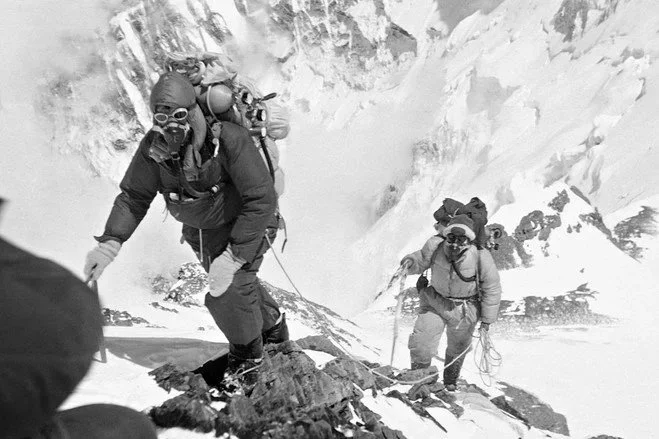
Peak hour traffic jams.
Even the words are enough to send a shiver down your spine.
Stuck in the same spot for what feels like an eternity, inching forward at a top speed of 5km per hour, with a furious fellow commuter waving their fists (or other hand gestures) as they cut you off. All to the sweet symphony of rage-filled beeping and muffled swearing.
Now imagine that peak hour traffic jam is happening at the top of Mt Everest. And the worst thing that can happen is not that you’re late to work again, but the fact you might… well, die (which is what literally happened to 11 climbers in 2019).
Yes, the giant, freezing death triangle at the top of the world has somehow become the ultimate badge of honour for people who voluntarily spend $100k to freeze, vomit, sleep on the ground, and contemplate their mortality at high altitude.
For Nepal, one of the poorest countries in the world, Everest has evolved into a multimillion-dollar industry powered almost entirely by Westerners with a thirst for conquest and a LinkedIn bio that needs a personality.
For many, this isn't just about mountaineering for mountaineering’s sake anymore.
It's about branded “achievement tourism”.
Let's unpack how Everest went from impossible dream to Instagram backdrop, and what it teaches us about the commodification of prestige.
PRINCIPLE 1: PROGRESS & GAMIFICATION
Success has levels to it, and Mt Everest is no exception. The climbing route itself is brilliantly designed (albeit accidentally) as a progress recognition system.
From Base Camp to Camp 4, every stage is a milestone. Base Camp? Congrats, you completed the beginner quest. Khumbu Icefall? You’re really on a side-quest now. And who can deny that the Summit feels like the final boss?
Humans are hardwired to chase progress, especially when we can physically see the payoff. Each milestone marker becomes a micro-celebration, a dopamine hit that keeps climbers motivated through weeks of misery. It turns the entire climb into a series of quantifiable, trackable, brag-able moments. And social media amplifies this beautifully, when every camp becomes a post, every obstacle overcome becomes content, every near-death experience becomes engagement.
The mountain has accidentally become the ultimate storytelling framework that puts Netflix to shame: a clear beginning, escalating challenges, a dramatic climax, and (if you're lucky) a triumphant return home.
PRINCIPLE 2: PROPRIETARY EPONYMS
Panadol. Velcro. Tupperware.
Or, if you aren’t specifically buying from one of these brands: paracetamol, hook and loop fastener, and plastic storage containers.
Sounds super weird, right?
We don’t even question most of these anymore, and why? Because these brands have so firmly cemented themselves into the market space for their products that we can’t even imagine calling them by any other name, even if it smells as sweet (shoutout to William).
The challenge that Mt Everest poses to its willing victims is clearly, concisely, and undeniably obvious. You don't need to explain what Everest means. It's become cultural shorthand for “the hardest thing you could possibly attempt”.
(Let’s be honest: no one says “wow, that project really felt like finishing a long hike to the top of the local hill!”)
CEOs talk about "climbing their Everest." Self-help gurus use it as a metaphor for overcoming obstacles. Heck, there's probably a motivational poster in your office right now featuring a snow-capped peak and something vaguely inspirational about the power of persistence.
The death-defying, gruelling, living off packet noodles challenge of Mt Everest has become the kind of brand identity that businesses would happily kill for, and all without paying for a single Facebook ad.
PRINCIPLE 3: MANUFACTURED SCARCITY
Do you actually know a person in your life who has climbed Mt Everest? Odds are, probably not.
Whilst every man, woman, or dog on social media seems to be running a marathon or doing Hyrox (seriously, is there some sort of cognitive change when everyone turns 30??), it’s safe to say that not many of your distant Facebook friends are hiking to the top of one of the most dangerous summits in the world.
It seems like a journey for only the elite, the distinguished, those rare people in society who have the kind of life story that would make any Hallmark exec weep.
Spoiler alert: it’s actually very easy to sign up for an Everest hike.
Everest's brand power relies on it being an unattainable bucket list item for most… while its economic model depends on mass participation in the thousands.
In the last 20 years, summit attempts have increased tenfold. More than half of all 10,055 successful summits have occurred in the last decade. In 2019, 876 people summited in a single season, creating literal traffic jams at 29,000 feet that contributed to 11 deaths.
This illusion of exclusivity is maintained through storytelling, even as the experience becomes increasingly commodified. It's the same strategy luxury brands use when they "limit" production while somehow always having stock available for anyone willing to pay the big dollars.
Unlike the usual suspects employing this technique (looking at you, Hermes), for Nepal, this illusion is existential in its roots. Everest generates over $300 million annually for one of the world's poorest nations. No one is mad at this sort of market manipulation: the locals gain a source of income, and the accountant gets to add “climbed Mt Everest” to their Insta bio.
So really, everyone wins!
PRINCIPLE 4: COMMUNITY BUILDING
Climbing Mt Everest enters you into a very exclusive club.
No amount of discreetly passed cash will sway the bouncer at the door. You pay in mild frostbite, altitude sickness, and blisters that make you dream of a time you were able to still wear open-toed slides.
When you survive something together (even if it’s weirdly voluntarily), you form an unshakeable connection, not just to your fellow climbers, but to the idea of Mt Everest itself. It's the same principle that turns Europe frequent flyers into insufferable dinner party guests (no, you didn’t pick up an accent from your 5 days in France).
Shared hardship creates identity, and identity creates community, and community creates a self-perpetuating marketing engine that requires zero advertising spend.
People love to share stories about themselves - you don’t need to ask someone if they’ve climbed Mt Everest, they will tell you about it (completely unprompted). And what’s better than describing in intricate detail the toilet situation on the mountain, then swapping stories with someone else who also lived it?
PRINCIPLE 5: PRESTIGE
It’s an age-old philosophical question: if a tree falls in a forest with no one to hear it, does it make a sound?
Mt Everest has it’s own version: if you climbed the summit but didn’t post it on Instagram, did you really climb it?
The social capital of posting a photo online at Base Camp is almost unmatched. For a certain class of wealthy achievers, Everest is the ultimate resume line, the conversation dominator, the humble-brag that requires no humility. It says: "I have conquered the unconquerable. I have disposable wealth. I have free time. I am extraordinary."
This is conspicuous achievement, or Thorstein Veblen's theory of conspicuous consumption updated for the experience economy. You're not buying a Rolex (though you probably own one), you're buying proof of exceptionalism.
And unlike most luxury purchases, Everest can't be faked, inherited, or gifted. You have to physically drag your body up that mountain, and this creates a form of prestige that feels earned (even when you've essentially paid Sherpas to do the hard parts).
The genius is that the achievement remains prestigious even as it becomes increasingly accessible.
Because you know, and we know, the story you tell conveniently omits the 100-person traffic jams, the Nepalese guide walking the whole way in Birkenstocks, and the donkey carrying your backpack up that really hard bit that made your summit possible.
PRINCIPLE 6: ASPIRATIONAL ACCESSIBILITY
In 1985, Dick Bass became the oldest person (at 55) to summit Everest, and more importantly, he popularised the concept of the Seven Summits: bagging the highest peak on each continent.
But Bass wasn't a professional climber. He was a Texas oilman with disposable income and an itch for glory. His success sent a very specific message to wealthy amateurs worldwide: You don't need to be extraordinary. You just need to be rich.
This is aspirational accessibility in action. It’s the same psychology that Ralph's Coffee uses to sell (and justify) $14 lattes. You're not buying the product; you're buying permission to belong to an exclusive club that's just accessible enough to feel attainable.
Suddenly, Everest wasn't for superhuman athletes. It was for middle-aged executives having midlife crises, Instagram influencers chasing content, and anyone with six figures burning a hole in their North Face jacket.
The mountain industry capitalised on this beautifully. Guided expeditions emerged offering "all-inclusive" packages: Sherpas carry your gear, fix your ropes, practically drag you up the mountain.
You don't even need technical climbing skills anymore. You just need stamina, cash, and a willingness to ignore the bodies you'll step over on the way up.
If you ever need proof that branding beats logic, safety, and basic human survival instincts, look no further than Mt Everest. It's a $100,000 participation trophy that kills 4% of its recipients, and somehow people are still happily lining up for the privilege.
So the next time someone casually mentions they've summited Everest in a dinner party conversation, know what you're really hearing: the sound of a brilliant brand strategy, weaponised as personal mythology.
And hey, maybe that's okay.
After all, we're all climbing our own Everests, whether they're 29,000 feet tall or just metaphorical mountains of email we swore we'd get through today.
I guess the only difference is, you can’t put “Got through my inbox” on LinkedIn as a “skill”.
How to Apply These Strategies to Your Own Brand
You don't need a 29,000-foot death trap to build the kind of magnetic brand power that Mt Everest has (accidentally) perfected. Here's how to borrow from the mountain's playbook, no frostbite required.
1. Build a Progress System Your Audience Can Follow
People are obsessed with milestones. Give your customers a visible journey, whether that's a loyalty program with clear "levels," a step-by-step framework they can move through, or a transformation story they can track. When people can see how far they've come (and how close they are to the next milestone), they stay invested. Bonus points if every stage is shareable.
2. Create a Community Worth Belonging To
The brands that win long-term are those building rooms people want to be in. Shared experiences, inside jokes, a common identity: these are the things that turn customers into advocates who market your brand for free. Find the "shared hardship" equivalent for your audience (a challenge, a mission, a movement, a villain) and rally people around it.
3. Make It Aspirational and Accessible
The sweet spot is making your brand feel premium and exclusive, while still giving people a clear entry point. So, like a hero offer or product that feels like a stretch, paired with a lower-barrier way in (a free guide, a taster session, an introductory tier, a cheaper product). Let people see themselves in your brand before they buy, and make the first step feel like joining something bigger than a transaction.
Oh, and if you liked this brand strategy breakdown of a not-quite-business, make sure you read our exposé on the Loch Ness Monster!